Blogs and Posts
Why These Stories Matter
These cases - and many others - share a common theme:
The truth only comes out when someone is willing to dig for it.
Attorneys rely on investigators not just to gather facts, but to challenge assumptions, expose errors, and ensure that every client receives a fair defense. Real‑life stories like these show the power of thorough investigation and the difference it can make in someone’s life.
Below are real‑life stories (with identifying details changed for privacy) that show how a thorough investigation can expose misconduct, reveal inconsistencies, and protect the rights of the accused
📞 Ready to Strengthen Your Next Case?
If you’re a defense attorney, or a private client looking for an investigator who brings decades of experience, meticulous attention to detail, and a proven track record of uncovering the truth, I’m here to help.
Let’s build a stronger defense - together.
When a simple insurance check turns into a cross border criminal case
Every investigator knows that some cases start small — a routine claim, a simple question — and end up revealing something far bigger. This one began with a supposed workplace injury and ended with federal agents uncovering a smuggling tunnel beneath a farm.
The Claim That Didn’t Add Up
John was an immigrant lumber mill worker who never quite fit in. His coworkers described him as lazy, unhygienic, and unwilling to follow basic safety rules. After repeated attempts to help him adjust, one lunch break ended with them hosing him down — and suddenly, John claimed he’d been injured on the job.
He filed a total disability claim, insisting he was bedridden and unable to work. His wife backed him up, and visiting therapists reported that he was completely incapacitated. But something about the story didn’t sit right with the insurance company.
During home visits, therapists noticed odd changes around the property — piles of dirt, sawdust, and straw near the barn, and an increasing number of potted bushes. The company called us to verify John’s condition and determine who was actually working on the property.
The Surveillance Begins

John’s farm sat on twenty acres, most of it hidden behind a hill. From the road, only the house and barn were visible. The barn was heavily padlocked, and an unknown man named Tom frequently arrived — sometimes on a motorcycle, sometimes in a new pickup — unloading lights, electrical equipment, and rolls of plastic.
Nursery trucks came and went, delivering more plants and materials. Something was happening behind that hill, and it wasn’t rehabilitation.
Persistence Pays Off
One morning, our surveillance caught John riding a tractor with one of his sons — hardly the behavior of a bedridden man. He disappeared over the hill and didn’t return for hours. We needed a better vantage point.
After speaking with neighboring cattle farmers, we learned they had once leased John’s land for grazing but had been told he was converting it into a blueberry farm. One neighbor offered access to their back field so we could continue surveillance.

At dawn the next day, we saw rows of freshly tilled soil and newly planted blueberry bushes. Then John appeared — digging post holes, stringing wire, burying water lines, and shoveling sawdust. His wife brought lunch, and after eating, John wrestled playfully with his sons before returning to work.
Clearly, he wasn’t disabled.
The Hidden Crop
The following morning, from a new position, we noticed a pungent odor drifting on the breeze. Investigating further, we discovered over 100 marijuana plants at various stages of growth, complete with an automated irrigation system. Later, John inspected the area himself before returning home.
The next day, we saw him wave to Tom, who arrived on his motorcycle and opened the barn door. Inside, we glimpsed rows of brightly lit plants covered in plastic sheeting — a full scale indoor grow operation.
We followed Tom to several other locations known for drug activity from prior investigations. The pattern was unmistakable.
The Breakthrough
We reported our findings to the insurance company and law enforcement. Weeks later, headlines confirmed what our surveillance had uncovered:
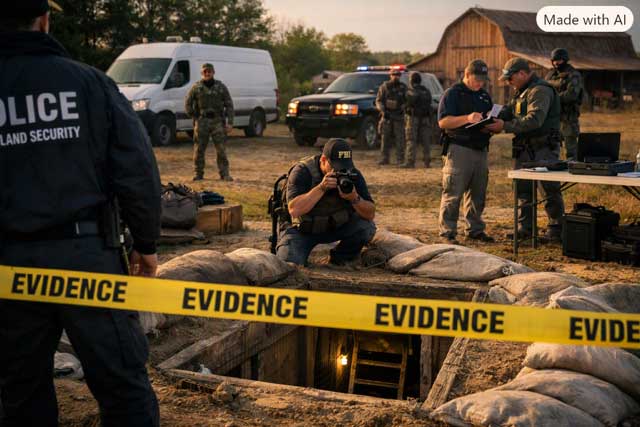
John and Tom were arrested in a joint U.S.–Canadian drug trafficking operation, which exposed a sophisticated smuggling tunnel near a border crossing.
What began as a fraudulent injury claim ended as an international criminal case.
The Investigator’s Lesson
An experienced investigator knows that every case can change direction without warning. The key is to adapt, observe, and capitalize on opportunity. What started as a simple surveillance assignment became a major breakthrough — because we didn’t stop at what was visible.
Need a discreet, thorough investigation?
Whether it’s insurance fraud, workplace misconduct, or something far more complex, our team has the experience to uncover the truth.
Contact us today for a confidential consultation.

Introduction
From the Chinese manufacturers, to the international shipping company, to west coast warehouses, to end users across Canada and the United States, to the factoring company that advanced millions of dollars against the sales of these goods, and the one employee who pocketed the funds
Situation
John was the regional manager for an international weight and equipment distributor across Canada and the United States.
The corporation imported container loads of weights, equipment, and machinery from factories in China.
The goods were purchased from China through wire transfers and Ocean Bills of Lading.
The goods were shipped in 20-foot containers on a US shipping company fleet of cargo ships.
Maritime law states that the holder of the Ocean Bills of Lading is the legal owner of the goods.
The full containers were delivered to distribution warehouses in Los Angeles, Seattle, and Vancouver BC, where the goods were unpacked, assembled, and trucked to retail stores and chains across Canada and the United States.
It is a common practice for corporations and large companies to receive signed orders from retail chains and other companies, and then to order the items to fill these sales from offshore manufacturers at a much lower price. In order to pay for these items to be manufactured prior to receiving payment, these corporations often use "Factoring Companies" who advance them 80-90% of the signed invoice/order amount and have the customer pay the factoring company directly upon delivery.
John was authorized by the corporation to oversee the sales and distribution affairs of the corporation, and was entrusted to wire funds to the factories, and to coordinate the ocean bills of lading from their Chinese origin to their north American distribution centers.
The factoring company first noticed something was wrong when their receivables started to drop, but their advances to the corporation continued, and even started to increase.
The corporation contacted state and federal police agencies for help but they were turned away due to the agencies being too busy to investigate. The corporation then reached out to us for help, so we accepted their case and started our investigation.
We gathered and analyzed sales data, invoice information, and transportation documentation and quickly realized that hundreds of thousands of dollars were unaccounted for.
We ran background and lifestyle checks on the corporation employees and management in order to identify the individuals with the Means, Motive, and Opportunity to commit the fraud and embezzlement. We soon identified our initial list of suspects.
These were employees who had access to some or all of the documentation necessary to embezzle funds, and ability to steal equipment from the warehouse, and had a recent change in financial circumstance.
We then conducted surveillance and deeper background investigations on the suspects and verified that one individual (John) was taking frequent trips to a previously unknown and undisclosed warehouse in another state, and staying under an alias in a nearby apartment.
Our investigation also uncovered that containers from the equipment manufacturer, in bond on a ship from China were unloaded onto a non-bonded ship before reaching the destination port, and had been diverted to this same warehouse, unloaded and returned to the shipping company.
We interviewed multiple clients of, and distributors of, the corporation and discovered they had been the benefactors of steeply discounted "deals" proffered by John, and believed they were assisting the corporation in liquidating old inventory to make room for 'new product lines'. Similarly diverted containers were also shipped directly to these clients at other locations across Canada and the United States.
We were able to access this leased warehouse and located transportation documents, ocean bills of lading, and left over inventory that connected John to the building, incoming containers, and outgoing shipments.
John had the Means and Opportunity to commit theft and fraud against the corporation and embezzlement against the factoring company, and appeared to be living beyond his salary, giving us a financial Motive.
After reporting to and showing our evidence to the factoring company attorney, we were asked to meet with the attorney and the district attorney office to help present their case.
As a result, we were able to provide enough Probable Cause to obtain a civil search warrant for John's residence, outbuildings, vehicles, with local law enforcement present on standby.
We arrived at Johns $1.4 million dollar residence at 6am, prior to him leaving for work, and provided a third-party attorney to explain his rights and obligations to him regarding the search warrant.
John asked for time to call his own attorney before we entered, and after five minutes, we were allowed to enter the residence and start our search.
In the kitchen we were able to locate ripped up invoices, telephone bills, and bank statements that were hidden beneath the trash bag in the trash bin.
In the garage we located a fully restored 1957 chevy corvette, that was previously unknown to us, and a brand-new Cadillac Escalade. We also searched these vehicles and recovered receipts and collectibles from recent cruises to Alaska, the Mexican Riviera, and the Caribbean.
In the spare tire recess of the escalade, we found more telephone and household bills that had been hidden there, along with the receipt and title for a Bayliner Explorer boat.
In the locked glovebox of the Corvette, we found several gold and gemstone jewelry items and two new Rolex watches.
In the master bedroom we located locked wall safe. John initially refused to provide us the combination or open the safe, but after a quick phone call to his attorney, and our willingness to call a locksmith to open it, he provided us with the combination.
Inside we located several gold and silver coins, investment documents showing over $500,000 in a mutual fund account.
We also found documentation that showed the house mortgage had been recently paid off in full, and the deed to a lakeside vacation home in another state.
John was arrested by police for fraud/theft and charges were filed.
Prior to trial, John was able to negotiate a plea deal with the prosecutor, avoid any further jail time, commit to 1 year EHM and probation, undergo counseling, and make full restitution to the corporation and the factoring company.
As a result, all of John's assets were seized and liquidated by the attorneys acting for the factoring company and the corporation, John's family divorced and left him, and he was only able to find work as a self-employed landscaper.
Hiring an experienced investigator can protect your rights, your safety, and your future.
Contact us today for a confidential consultation-
931-871-0563 or pi@pitag.com